

Visas for Immigrating to the United States
Living in the United States is a dream for many people, but as soon as you start reading about immigration, you quickly realize that the visa system can feel complex, technical, and sometimes discouraging. Between student visas, work visas, investor visas, exchange programs, and family-based options, it is not always easy to know where to begin. And yet, there are several very real ways to move to the United States today, whether your goal is to stay for a few months or to build a long-term life there.
If your objective is to settle in the country permanently, I also recommend looking at every option related to permanent residency and the Green Card. In this article, the goal is simpler: to explain the main visas for coming to the United States, how they work, their advantages, their limits, and which one may fit your personal situation best. Whether you are a student, an employee, an entrepreneur, or simply at the reflection stage, this guide will help you understand the big picture.
This article is informational only. Immigration law changes regularly and every personal case is different. For a concrete strategy, it is always wise to consult an immigration attorney or an official source.
Immigrant visa vs. non-immigrant visa: understanding the difference

Before looking at the various categories, there is one distinction you absolutely need to understand. In the United States, visas are generally divided into two large families:
- Immigrant visas, which are intended for people who want to obtain permanent residency and settle in the country for the long term.
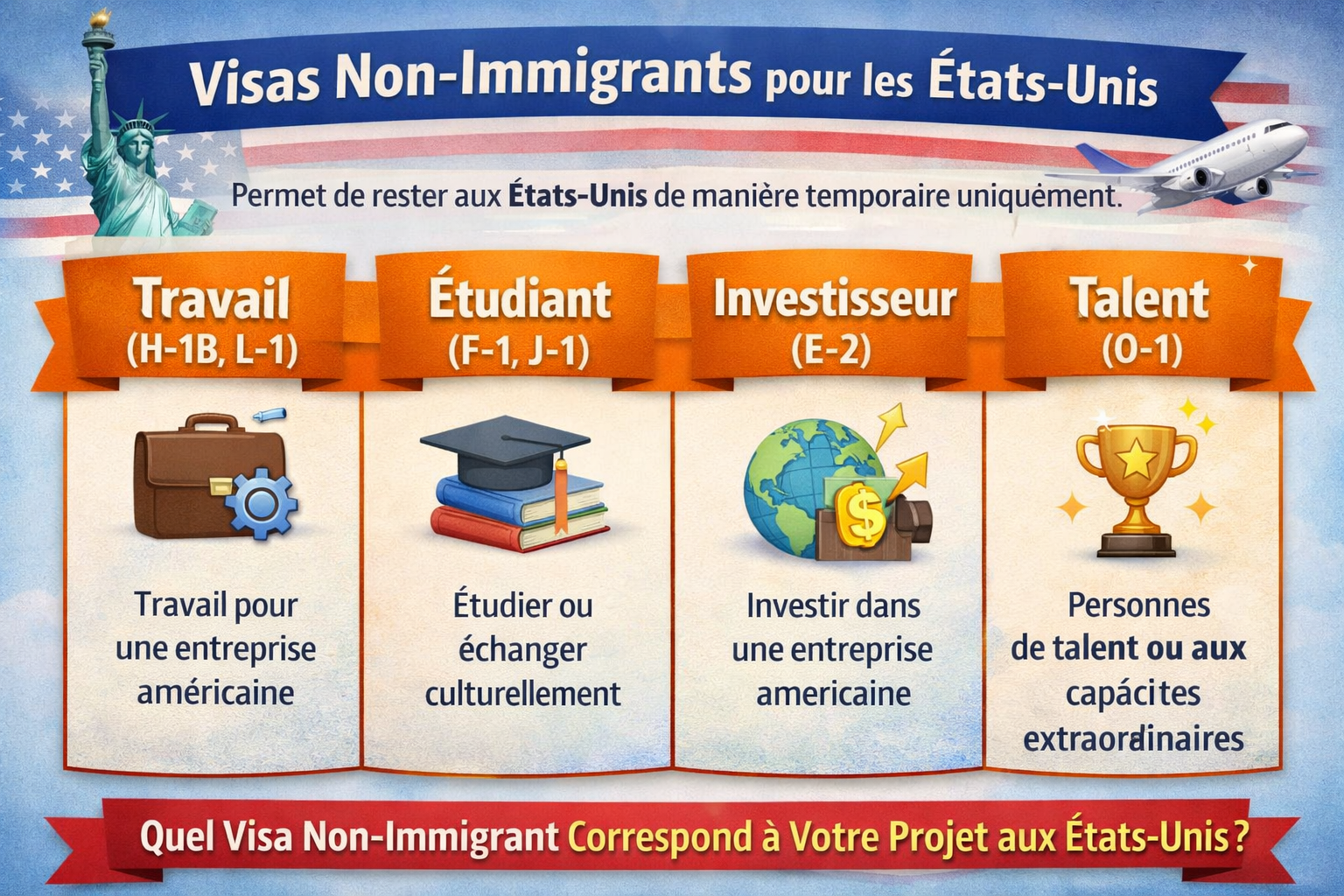
- Non-immigrant visas, which are designed for temporary stays for work, studies, tourism, training, business, or investment.
This distinction matters because some visas allow you to come for a limited period only, while others can be part of a longer immigration strategy. In other words, not every visa leads to a Green Card, and not every project should start with the same type of application.
The main immigrant visas
Family-based immigration
One of the best-known solutions is family sponsorship. U.S. citizens and, in some cases, permanent residents can sponsor certain close relatives. Immediate family members of U.S. citizens are generally treated more favorably than extended family categories, which can face longer waiting times.
The exact timeline depends on the relationship, the sponsor’s status, and the category involved, but family-based immigration remains one of the main legal paths for people who want to establish themselves permanently in the United States.
Employment-based immigrant visas
There are also immigrant visas linked to work and professional qualifications. These categories are generally intended for people with specific skills, advanced degrees, exceptional abilities, or job offers from U.S. employers willing to sponsor them. The process can be long and administrative, and some categories require labor certification first.
Diversity Visa Lottery
The famous Green Card Lottery, officially called the Diversity Visa Program, is another path. It is based on annual eligibility rules and is reserved for people from countries with historically low rates of immigration to the United States. Selection is random, but being selected is only the beginning: the winner must still meet all requirements and complete the file correctly.
The main non-immigrant visas
Student visas: F-1 and M-1
The F-1 visa is the classic student visa for academic programs, language schools, colleges, and universities. It is often the visa chosen by people who want to study in the United States, improve their English, or begin a serious educational project. It generally allows limited work possibilities only under strict rules.
The M-1 visa is more specific and concerns vocational or non-academic training programs. It is less common for traditional international students, but it exists for technical schools and similar programs.
Work visas: H-1B, L-1, O-1 and others
The best-known work visa is the H-1B, which is often used for specialized positions requiring higher education or technical expertise. It is highly sought after and subject to an annual cap in many cases, which makes it competitive.
The L-1 visa is designed for intracompany transfers. It can be useful when a company transfers a manager, executive, or employee with specialized knowledge from a foreign branch to a U.S. office.
The O-1 visa is intended for individuals with extraordinary ability in areas such as science, business, education, athletics, or the arts. It is more selective, but it can be a very strong option for applicants with a high-level profile.
Investor and business visas: E-2 and related solutions
The E-2 investor visa is one of the most discussed visas among entrepreneurs who dream of opening or buying a business in the United States. It requires a real investment in an active business and is reserved for nationals of countries that have the appropriate treaty with the United States. For many families, this visa is attractive because it allows an entrepreneurial project while also letting the spouse apply for work authorization.
However, it is important to understand that the E-2 is a non-immigrant visa. It allows you to live in the United States as long as the business remains active and the visa conditions are respected, but it is not, by itself, a Green Card.
Exchange visas: J-1
The J-1 visa covers a wide variety of exchange situations: au pairs, trainees, interns, teachers, researchers, camp counselors, and more. It can be a great way to discover the United States or gain professional experience, but some J-1 holders are subject to a two-year home residency requirement before they can change status or apply for certain other visas.
How to choose the right visa
The right visa always depends on your real project. Do you want to study? Work for a U.S. company? Be transferred within an existing company? Start a business? Join your spouse or your family? Build a path toward permanent residency? The answer changes everything.
A good starting point is to clarify five things:
- the purpose of your stay;
- the planned duration;
- your personal or family situation;
- your financial resources;
- whether your long-term goal is temporary residence or permanent residence.
Too many people lose time by focusing on a visa category that sounds attractive but does not actually match their profile. Immigration projects are expensive, time-consuming, and emotionally demanding. It is better to take time at the beginning and build the right strategy than to rush into the wrong process.
What this means in practice
If you are a student, the F-1 may be your natural entry point. If you already work for an international company, the L-1 could be worth exploring. If you want to invest and create a business, the E-2 may be a serious avenue. If you are sponsored by family, you may be in an immigrant process from the start. If you have rare qualifications, a work-based or talent-based option may fit better.
In all cases, patience is essential. U.S. immigration is not something to improvise. Documents must be exact, timelines matter, and rules can change. But with the right information and the right visa category, a move to the United States can become a realistic project rather than just a dream.
Final thoughts
There is no single “best” visa for moving to the United States. There is only the visa that best matches your project, your status, and your long-term plan. The most useful thing you can do is define your objective clearly, understand the differences between the main categories, and then move forward with realistic expectations.
The American immigration system can be complicated, but it is not impossible to navigate. The key is to choose the right route from the beginning.