
What If I Took My American Driver License?
What if I tried for an American driver’s license? More precisely: what if I tried for a Florida Class E Driver License? When you first move to Florida, the local driving rules can be surprising, and many details are not always intuitive for foreigners. The road signs, the school buses, the rules at intersections, and even the way some traffic situations are handled can differ from what we know in France.
This article was built in a playful way, almost like a quiz, to help you test your knowledge of Florida driving rules before taking things more seriously. Some statements are true, others are false, and the goal is simply to see whether you are already ready for the Florida driving culture or whether you still need a bit of practice.
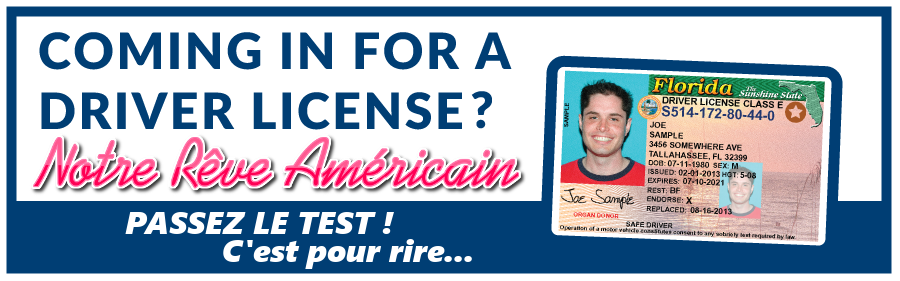
Florida Class E Driver License


The Class E license is the standard driver license for most private cars in Florida. For newcomers, understanding the local rules is essential not only for the written test but also for daily safety. It is not enough to know how to drive mechanically; you also need to understand local habits and traffic laws.
True or false?
The original article includes a series of practical questions based on real road situations. This is exactly what makes the exercise useful: it is concrete. The idea is not to memorize rules in the abstract, but to recognize what is expected in real driving conditions.
For example, all vehicles must stop in certain situations, school buses require particular attention, and the use of hazard lights is far more limited than many people imagine.
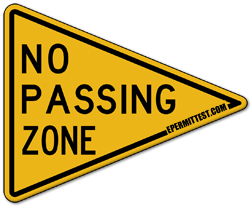
Hazard lights
One of the points that often surprises foreign drivers is the use of hazard lights. In this quiz, one of the answers is clearly false: it is strictly forbidden to drive with hazard lights on as if they were a normal signaling tool. Hazard lights are used for a stopped or disabled vehicle, not for normal driving. This is exactly the kind of detail that can trap people who are used to other local habits.
Stops and right of way
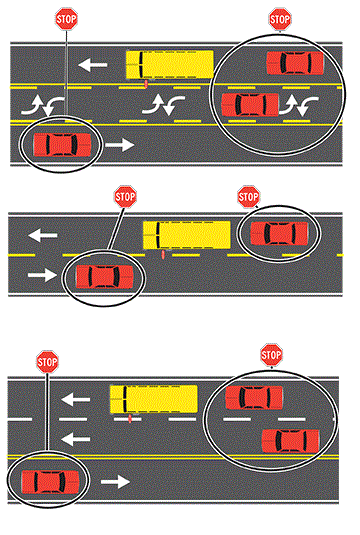
Florida roads also require you to be very attentive at stops, intersections, school areas, and pedestrian situations. In some cases, every vehicle must stop. In others, the order of arrival matters. These rules are easy to underestimate when you come from another country, but they are central to safe driving in the state.
Why this kind of quiz is helpful
Learning with practical examples is often much more effective than simply reading a long legal text. A playful quiz allows you to test yourself, spot your weak points, and better understand the logic of local rules. It is also a good way to realize that driving “well” in your home country does not automatically mean you know how everything works in Florida.
So, did you pass?
At the end of the article, the idea is simple: count your mistakes honestly and see whether you are already close to earning your Florida license or whether you would need another training session. It is a fun format, but behind it there is a real message: if you plan to drive in Florida, learn the rules seriously. It will make you safer, calmer, and much more comfortable on the road.
And if this first quiz was not enough, there is always room for another round before the real exam.
Why local rules matter so much
Florida driving culture contains a lot of practical situations that are easy to underestimate if you only rely on general driving instinct. School buses, stop signs, pedestrians, lane use, emergency lights, and intersection behavior all have local nuances. That is why even a playful quiz can be useful: it forces you to think in a specifically Floridian way rather than a generic one.

A good training tool for expatriates
For expatriates, this kind of exercise is reassuring because it transforms a stressful subject into something more concrete. Instead of facing the local rules as one big intimidating block, you tackle them step by step. It is a smart way to prepare yourself before the real administrative process.