Expats in the USA and Covid-19 – Part 1
At the end of January 2020, my friend Nancy told me that something serious was happening in China concerning a virus. Her parents were traveling in China at that time, and she informed me in real time that the situation was dramatic enough for extraordinary measures to be taken. It was one of the first times I heard about Covid-19. Honestly, at that moment it still felt far away and I did not feel concerned yet, except for the parents of my friend, whom I hoped would be able to return to France quickly.
At the end of February 2020, I took part in a workshop with other mothers in my eldest child’s classroom. We talked, among other things, about Covid-19, but still with the feeling that we were protected and far from all of that. The media spoke more and more about what was happening in Europe, and I was following those events from a distance, especially for our families and friends who were in France. Then in mid-March, everything changed: the United States had its first official cases, borders began to close, and life with this virus truly began.
When this article was written, in July 2020, the United States was at the heart of the Covid-19 storm while Europe had started to improve somewhat, even if many feared a second wave. In a future that was very difficult to predict, I wanted to know how the expatriates I knew in the USA were feeling in the face of this unprecedented health, economic, and social crisis. These are the testimonies that I propose to share in this article, first part.
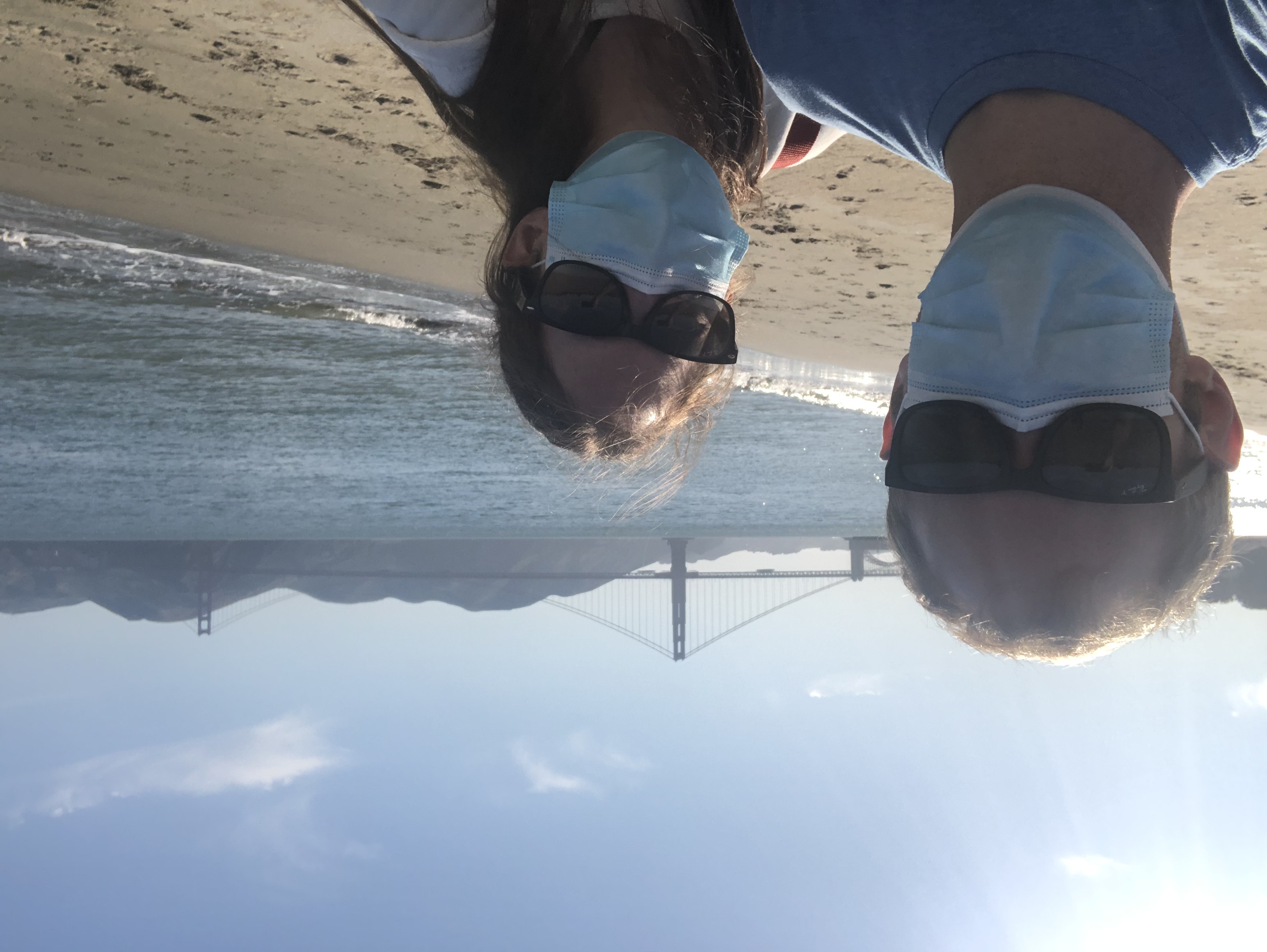
EMMA – SAN FRANCISCO, CALIFORNIA
1/ Hello Emma, could you briefly introduce yourself? Where do you live? Are you expatriated alone, with family, or as a couple? Why did you expatriate (job, family, etc.)?
Hello, my name is Emma and I have been living in San Francisco, California for four years. I first came alone to teach in an international school, but for the last two years I have been living with my American boyfriend Paul, who is an architect. We live in a small apartment near downtown. For now I am still on a J-1 visa.
2/ Since the start of Covid-19, how have your state, county, and city handled the crisis?
The city of San Francisco, which is also a county, is stricter than other cities in California. We have been in lockdown since March 17. Since June, shops have been able to welcome customers inside, but restaurants still had to serve people only outdoors. At the beginning of July, bars, hair salons, barbers, museums, and gyms were still closed. Wearing a mask was mandatory outdoors as well as indoors, even when practicing physical activity. Until May, the parking lots of parks were closed and we had to stay close to home. Fortunately, we can walk to Golden Gate Park from where we live, and we were able to enjoy its open spaces for picnics.
3/ And you, what was your own situation during this crisis (visa, job, travel, etc.)? What was your feeling about this unprecedented situation?
I was teaching on Zoom every morning with my students and my salary stayed the same. Paul, on the other hand, lost 20% of his salary even though he was working remotely. His company sent him a check for $50 each month for home-office expenses, and we used that to buy a desk and a webcam. California reimbursed part of the 20% he lost, and he also received the Covid bonus, so in the end he was earning slightly more than his usual salary, which was a nice surprise. At that point it was not planned for him to go back to the office.
The first months were difficult in our small apartment. We were both in the living room all day doing video conferences. It was noisy, and we had only one real desk. Paul was standing behind the kitchen counter with his screen perched on a pressure cooker. Since I went on vacation, we arranged a small office corner in the bedroom for him so that he could work more quietly and we could get our kitchen back.
What this testimony highlights very clearly is how the pandemic affected expatriates not only through general restrictions, but also through housing conditions, work arrangements, emotional fatigue, and the constant comparison with what was happening in France. Being abroad during such a crisis changes the way you experience uncertainty.
This is also why testimonies like Emma’s are valuable. They make the crisis more human and more concrete. Beyond numbers and news headlines, they show what daily expatriate life looked like during those first months: remote work, visa uncertainty, adapting to local rules, and the emotional weight of being far from loved ones.
For many expatriates, Covid-19 was not only a health crisis. It was also a crisis of distance, of logistics, of isolation, and of perspective. That is what makes these interviews important.
Covid-19 through the eyes of expatriates in the USA reveals a very specific and deeply human side of life abroad during a global crisis.
A crisis lived through the lens of expatriation
What makes this topic particularly important is that expatriates did not experience the pandemic only as residents of the United States. They also experienced it through the specific lens of living far from their home country, their families, and often under different visa or administrative conditions. That changes everything in the way uncertainty is felt.
During a global crisis, being abroad can intensify practical concerns: travel restrictions, family separation, access to information, job insecurity, housing constraints, and the question of whether one could even return if necessary. These are not secondary worries. They shape the whole emotional experience of the period.
Why testimonies matter so much
That is exactly why these interviews are valuable. They bring back the concrete reality of daily life during that period: small apartments turned into offices, local rules that changed from one city to another, remote work, changing budgets, and the constant comparison with what relatives were experiencing elsewhere, especially in France.
Numbers and headlines tell one story of Covid-19. Testimonies tell another. They show how the crisis was actually lived from inside everyday life.
An important expat memory of 2020
For many expatriates in the USA, Covid-19 became one of the major shared memories of life abroad. Not only because of the health situation itself, but because it tested adaptation, resilience, emotional balance, and the relationship to distance.
That is why this first part matters. It captures a human and expatriate perspective on a historical moment that affected everyone, but never quite in the same way.
Through expatriate testimonies, Covid-19 in the USA becomes a deeply human story of distance, adaptation, and uncertainty abroad.
Between local rules and emotional distance
One of the most striking aspects of the expatriate experience during Covid-19 was that everything depended both on local American rules and on what was happening in the home country. Expatriates were therefore often living in two realities at once: the reality of their American state or city, and the emotional reality of worrying about family members abroad.
This double perspective made the crisis feel especially intense. Even when daily life remained manageable, the sense of uncertainty could remain very strong because relatives were far away and travel was no longer simple or even possible.
A uniquely expatriate perspective
That is why it is important to document this period through expat testimonies. They reveal not only how the USA functioned locally during the pandemic, but also how being abroad transformed the emotional and practical experience of the crisis. Fear, adaptation, resilience, distance, and logistics all became intertwined.
For many people living abroad, the pandemic was one of the moments when expatriation felt the most concrete and the most fragile at the same time. It highlighted both their integration into daily American life and the fact that part of their emotional center remained elsewhere.
Why this first part matters
This first part is therefore not simply about Covid-19 in a general sense. It is about what the crisis looked like when filtered through the lives of expatriates in the United States. That nuance matters because it brings out elements that are often absent from broader national narratives.
Through these interviews, we understand better what it meant to live through 2020 while being far from home, attached to two countries at once, and trying to maintain some stability in a world that had suddenly changed.
For expatriates in the USA, Covid-19 was not only a global crisis: it was also a deeply personal test of distance, belonging, and adaptation.
The value of personal stories during a global crisis
When a crisis is global, it is easy to speak only in statistics, restrictions, and political decisions. But what these expatriate testimonies restore is the concrete human scale of the period. They show apartments suddenly turned into offices, children adapting to new routines, couples reorganizing their lives, worries about visas, and the constant tension of living in uncertainty.
That is particularly important for expatriates because their situation is often more fragile than it appears from the outside. A work contract, a visa status, a planned trip, an administrative deadline, or a family emergency can all take on much more weight when international movement is complicated or restricted.
A shared memory for people living abroad
For many people living in the USA far from their home country, Covid-19 became one of those moments that permanently mark expatriate memory. It was a period when distance felt heavier, when the idea of “being abroad” took on a different emotional meaning, and when daily adaptation had to happen under pressure.
Some discovered that they were more rooted in their American life than they had thought. Others felt, on the contrary, how strong their attachment remained to France or to relatives elsewhere. In both cases, the crisis revealed something deep about what expatriation really means.
Why this first part should be read as more than testimony
This first part is therefore not just a collection of opinions. It is also a document of lived expatriate history during an extraordinary period. It captures how people interpreted local rules, managed work and family life, dealt with isolation, and tried to remain stable while the surrounding context was changing rapidly.
That is exactly what gives this kind of article its value. It preserves a nuanced, grounded, and deeply human perspective on a moment that was often discussed in very abstract terms.
These expatriate testimonies turn Covid-19 in the USA into a lived story of uncertainty, resilience, distance, and adaptation abroad.