
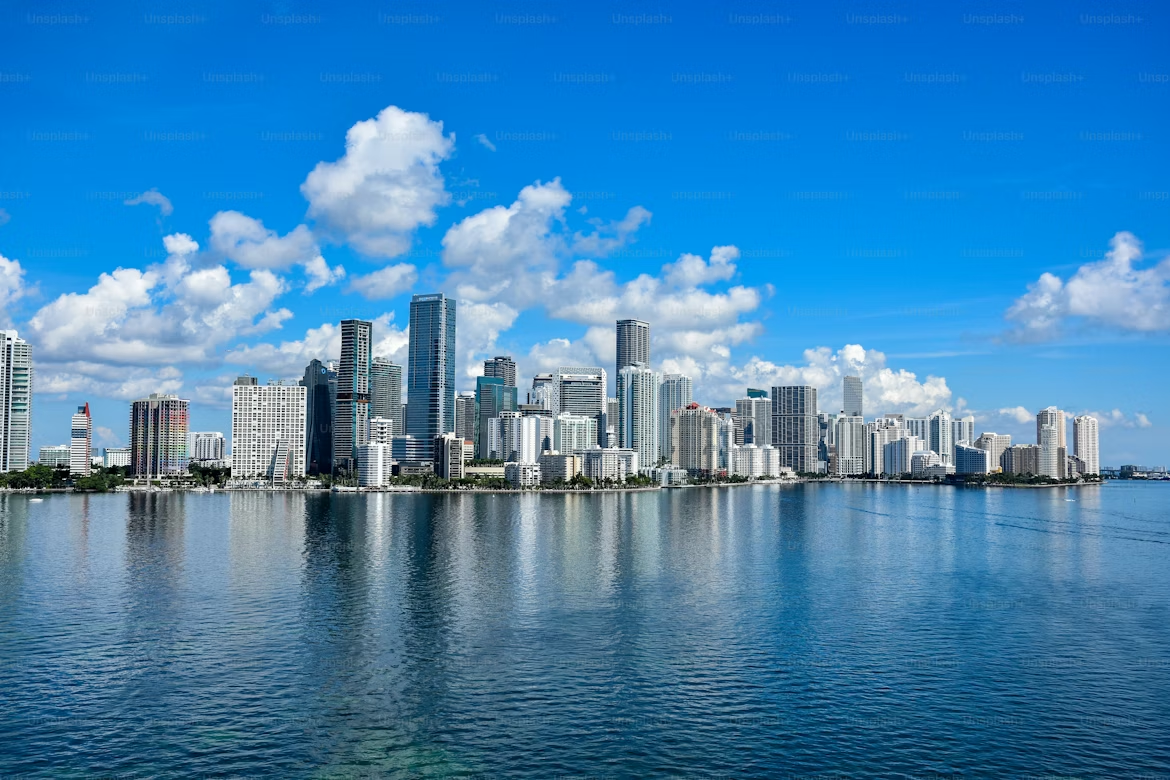
Florida attracts many people every year thanks to its climate, lifestyle, beaches, and the absence of state income tax. On paper, everything seems ideal. Yet one question comes up again and again: what is the real cost of living in Florida in 2026?
After almost ten years in the United States, we have seen the situation evolve very concretely. As elsewhere, the cost of living has risen sharply since 2020, and Florida is no exception. Housing, insurance, healthcare, cars, and groceries: living in Florida is still possible, but today it requires a much higher budget than just a few years ago.
In this article, I share realistic budgets, prices observed in 2025–2026, and our personal experience to help you better understand the true cost of life in Florida.
🚗 Compare rental car prices and book the best deal here.
The average cost of living in Florida in 2026
On average, the monthly budget needed to live in Florida now tends to be around:
- Single person: $3,000 to $4,000 per month
- Couple: $4,000 to $6,000 per month
- Family of 4: $5,500 to $9,000 per month
Housing and health insurance are generally the biggest expenses. Depending on the city chosen, lifestyle, and type of housing, the budget can vary enormously.
Housing in Florida: the main expense
Housing remains by far the most important spending category, and also the one that has changed the most in recent years.
In Florida, it is important to distinguish two situations:
- renting
- buying real estate
Prices vary enormously depending on the city, neighborhood, distance to the coast, age of the property, and the amenities available (pool, gym, gated community, HOA, etc.).
Renting in Florida in 2026: real prices by city and neighborhood

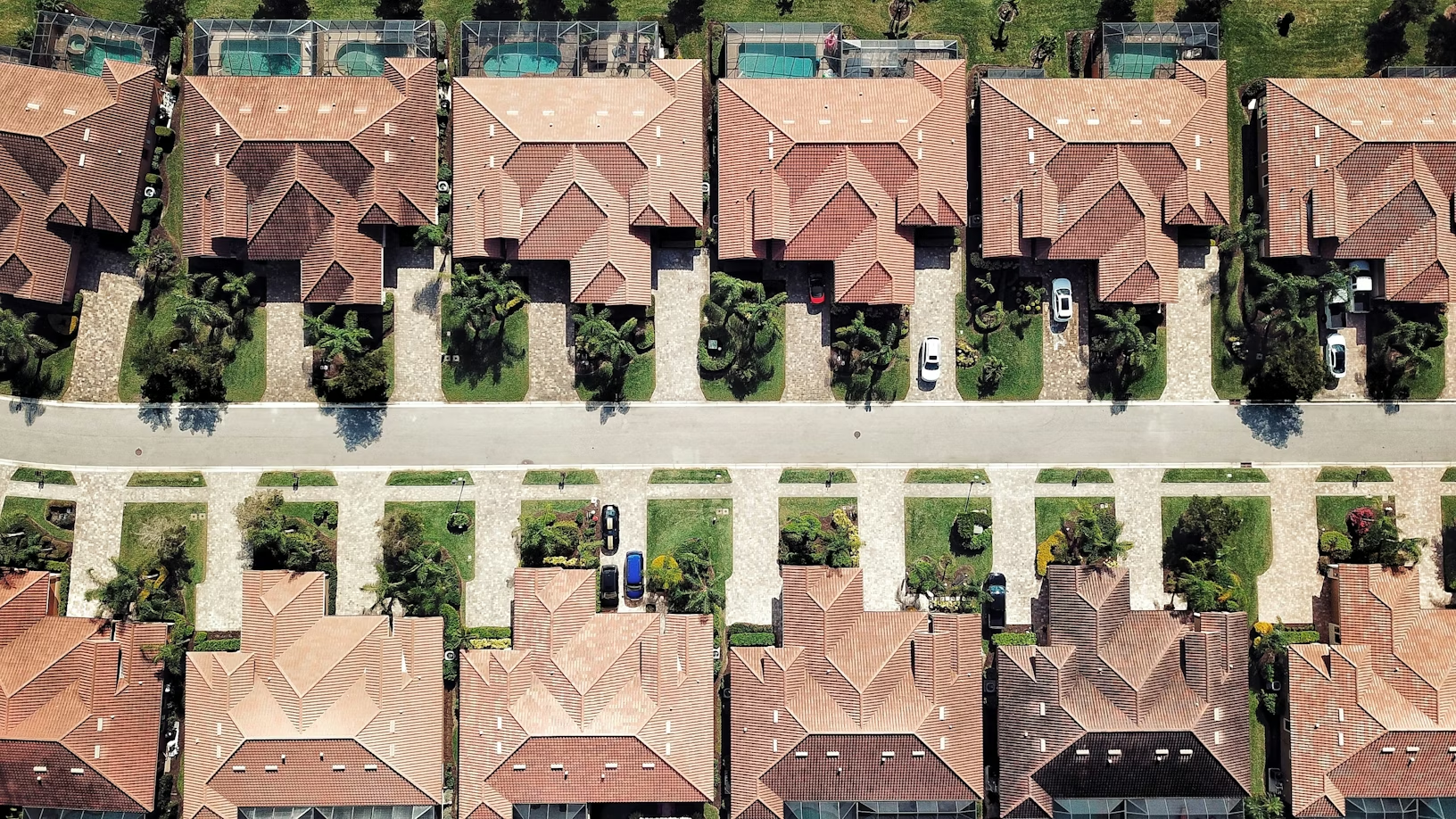
Rents vary widely in Florida depending on the city, neighborhood, and distance to the coast
Rents vary dramatically not only from one city to another, but also from one neighborhood to another. Proximity to the beach, the age of the residence, and amenities such as a pool, gym, security, or gated access all influence the price.
🛡️ Compare travel insurance plans and find the right coverage for your trip.
Why the cost of living has changed so much
The idea that Florida is automatically “cheap” compared with other U.S. states is no longer accurate in many areas. Since 2020, strong migration, pressure on the housing market, higher insurance premiums, and general inflation have pushed budgets upward. Florida can still be attractive, but it requires more realistic financial planning than before.
This is one of the main reasons articles about the cost of living matter so much now. They help future residents or expatriates replace fantasy with actual numbers and understand how different Florida realities can be depending on region and lifestyle.
A budget question above all
Living in Florida is therefore not only a matter of taste or climate. It is a question of housing strategy, insurance costs, health coverage, transportation, and daily spending habits. Someone who dreams of the coast, a house with a pool, and private health insurance will not face the same budget as someone living inland with a more modest lifestyle.
That is why the phrase “cost of living in Florida” always needs nuance. There is no single cost of living in the state, only very different realities depending on the city, the family structure, and the life you are trying to build.
The real cost of living in Florida in 2026 depends heavily on housing, insurance, healthcare, and the lifestyle you want to maintain.
Why this question has become so important
The cost of living question has become central because Florida’s image has continued to attract new residents at the same time that the state has become more expensive. Climate, beaches, tax advantages, and quality of life still draw people in, but those advantages now need to be weighed against a much heavier financial reality than many expect.
That mismatch between dream and budget is one of the reasons realistic articles like this matter so much. They help replace assumptions with concrete financial perspective.
No single Florida budget exists
One of the biggest mistakes people make is to imagine that “the cost of living in Florida” is a single number. In reality, the state contains radically different situations depending on the city, the neighborhood, the distance to the coast, family size, healthcare choices, and daily habits. A modest inland life and a coastal family lifestyle with private insurance can produce completely different monthly budgets.
This is why salary expectations also need nuance. A salary that feels acceptable in one part of Florida may be insufficient elsewhere once rent, insurance, and transportation are factored in.
Housing and insurance change everything

For many households, housing remains the main pressure point, but insurance – whether health, home, or car can quickly become just as decisive. These categories shape the whole budget and explain why some newcomers underestimate the real cost of settling in Florida.
In that sense, Florida remains attractive, but no longer inexpensive by default. It rewards preparation far more than improvisation.
A reality future residents need to understand
Anyone thinking of moving to Florida, retiring there, or expatriating there needs to understand this clearly: life in the state may still be desirable, but it requires planning, realistic numbers, and often a stronger income than older stereotypes would suggest. The state is not impossible financially, but it is no longer the easy bargain many imagine.
This is especially true after the inflationary changes of the last few years. Looking at real budgets rather than general reputation is now essential.
The true cost of living in Florida in 2026 can only be understood through realistic housing, insurance, healthcare, and lifestyle calculations, not through clichés about sunshine and tax advantages alone.
Why realistic budgeting matters more than ever
One of the biggest risks for future residents is arriving in Florida with an outdated perception of the state’s affordability. In many cases, that image no longer matches reality. A realistic budget is now essential not only for comfort, but often simply for stability. Underestimating housing, healthcare, or insurance can very quickly create stress and financial imbalance.
This is especially true for families and for people arriving from abroad, who may not yet be familiar with the way American expenses accumulate month after month.
The Florida dream now needs financial precision
Florida still offers undeniable attractions: weather, lifestyle, tax advantages, beaches, and a strong quality-of-life image. But those attractions no longer remove the need for careful financial planning. In fact, the more desirable an area is, the more necessary that planning becomes.
That is why the question is no longer simply “Is Florida attractive?” but rather “Can the life I imagine there actually be financed in a sustainable way?” That shift in perspective is crucial.
A useful reality check for future movers
Articles like this are useful because they act as a reality check. They help people compare fantasy with numbers and understand that there is no one-size-fits-all answer. Living inland, renting modestly, or simplifying one’s lifestyle can produce one financial reality; living near the coast with high insurance and a larger family produces another entirely.
For that reason, anyone thinking of moving to Florida in 2026 needs to think not only in terms of sunshine and salary, but in terms of total monthly ecosystem: rent or mortgage, healthcare, car costs, home and flood coverage, groceries, schooling, and everyday lifestyle.
Why this subject keeps growing in importance
The cost-of-living issue matters more every year because it now conditions who can realistically enjoy the Florida lifestyle and under what conditions. The state remains attractive, but attraction alone is no longer enough. People need solid numbers, clear expectations, and room for financial resilience.
That is what makes this subject so important for future residents, retirees, expatriates, and even current Floridians themselves.
In 2026, understanding the true cost of living in Florida requires detailed budgeting, realistic expectations, and a clear view of how housing, insurance, healthcare, and lifestyle interact.
A state that still attracts, but no longer cheaply
Florida continues to attract because it still represents a powerful lifestyle promise: sunshine, outdoor life, no state income tax, and a strong image of freedom and comfort. But this promise now comes with a much higher price tag than many newcomers imagine. The state is still desirable, but it is no longer automatically affordable.
This is why the budget question has become unavoidable. Attraction to Florida is still real, but it now has to be backed by stronger financial preparation than before.
Why future residents need realistic numbers
For people thinking about moving, retiring, or expatriating to Florida, realistic numbers matter because mistakes can have consequences very quickly. Housing alone can reshape an entire monthly budget, but once insurance, healthcare, transportation, and groceries are added, the overall picture changes even more. A move that looks feasible on paper can become difficult if costs have been underestimated.
That is why broad averages are useful only as a starting point. The real challenge is to understand how your own family structure, city choice, and lifestyle expectations interact with Florida’s rising costs.
A question of lifestyle as much as salary

The salary needed to live in Florida is never just a salary question. It is also a lifestyle question. The coast, a larger home, better school zones, private insurance, more driving, or a more comfort-oriented way of life can all raise the budget substantially. By contrast, a more modest inland lifestyle can remain much more manageable.
This means the subject cannot be reduced to one “good salary.” The required income always depends on the life you are trying to sustain.
Why this topic matters so much in 2026
In 2026, the cost of living question is no longer secondary. It is one of the central realities that conditions whether the Florida dream can actually work in daily life. Understanding this clearly is essential for anyone planning a move, because long-term comfort depends far more on budget realism than on stereotypes about sunshine or taxes.
The cost of living in Florida in 2026 is above all a question of realistic planning, because the lifestyle remains attractive but the financial margin for error is much smaller than before.
Florida still attracts, but budgeting now decides everything
One of the clearest lessons of recent years is that attraction to Florida is no longer enough on its own. The state may still offer climate, tax advantages, and lifestyle appeal, but the success of a move increasingly depends on the quality of the budget behind it. Financial preparation is no longer secondary; it is central.
That is why realistic articles on cost of living have become so important. They help future residents avoid treating Florida as an abstract dream and force them to evaluate it as a real monthly financial environment.
The importance of margin and resilience
Another issue that matters in 2026 is financial margin. It is not enough to calculate only the “minimum” needed to get by. In a state where housing, insurance, and other recurring expenses can fluctuate or increase, households need room for adaptation. This is particularly true for families, retirees, expatriates, and newcomers who may not yet know the system well.
A realistic budget therefore has to include not only average costs, but also resilience: the ability to absorb the unexpected without destabilizing everyday life.
Why this article matters for real-life decisions
The true value of an article like this is that it helps turn a vague desire into an informed choice. Someone thinking about moving to Florida does not only need inspiration. They need practical clarity: what kind of salary, what kind of housing, what kind of insurance burden, and what kind of trade-offs daily life may require.
That clarity can prevent expensive mistakes and help people choose a version of Florida life that is actually sustainable for them.
In 2026, living well in Florida depends less on fantasy and more on realistic budgeting, financial margin, and a clear understanding of total monthly costs.
Why financial realism now matters more than attraction
The key issue in 2026 is that attraction to Florida can no longer be separated from financial realism. Climate and lifestyle may still draw people in, but the viability of a move now depends much more heavily on whether the numbers actually hold over time. This is particularly true when healthcare, insurance, and housing all remain structurally expensive.
In practice, this means that planning a move to Florida requires more than enthusiasm. It requires scenario-building, realistic margins, and a clear understanding of recurring expenses beyond rent or mortgage alone.
A subject that now shapes migration choices
The cost of living has become one of the factors that most strongly shapes who comes to Florida, where they settle, and what kind of lifestyle they can maintain. It influences not only comfort, but also long-term stability and the possibility of enjoying what attracted people to the state in the first place.
That is why a cost-of-living article is no longer just practical information. It has become one of the central tools for anyone seriously considering Florida as a place to live.
In Florida in 2026, the success of a move depends not only on wanting the lifestyle, but on being able to finance it realistically and sustainably month after month.
Why “cheap Florida” is now an outdated idea
For many people, one of the most important things to understand is that the old idea of a broadly cheap Florida no longer corresponds to much of the current reality. The state can still offer advantages, but the equation has changed. Attractive climate and lack of state income tax do not automatically compensate for higher housing, insurance, healthcare, and day-to-day living costs.
This is why older perceptions of Florida can be misleading. The financial reality of 2026 requires more updated expectations and more careful projections.
The real question is sustainability

At the end of the day, the issue is not only whether someone can move to Florida, but whether they can sustain the life they imagine there over time. A budget may work for the first months and then become fragile once recurring expenses, renewals, and unforeseen costs accumulate. This is why monthly averages alone are never enough without margin and long-term thinking.
That is especially true for expatriates, retirees, and families, for whom stability matters just as much as immediate affordability.
Why this topic deserves detailed treatment
The cost of living in Florida in 2026 deserves a detailed article because it influences almost every major life decision connected to the state: whether to move, where to settle, what salary is needed, whether the coast is realistic, whether a family can stay long-term, and what compromises may be necessary. It is not a side issue. It is one of the main structuring realities of life in Florida today.
For that reason, realistic budgeting is no longer optional knowledge. It is one of the foundations of any serious Florida life project.
In 2026, understanding Florida means understanding its real cost of living, because every lifestyle choice in the state now depends on clear and sustainable budgeting.
Why people need updated expectations
One of the biggest practical problems for newcomers is that they often arrive with outdated expectations based on Florida’s older reputation. In many areas, those expectations no longer match current costs. This can create disappointment or even financial strain if the move was planned with numbers that are no longer realistic.
That is why updated articles and observed budgets matter so much. They help align expectations with current living conditions rather than with an older vision of the state.
The gap between attraction and affordability
Florida remains highly attractive, which is exactly why affordability has become such a central issue. The state’s appeal drives demand, and demand feeds pressure on housing and other costs. That dynamic means Florida can still offer a desirable quality of life, but often at a higher financial threshold than many people anticipate.
This tension between attraction and affordability is now one of the defining realities of life in Florida.
Why this subject affects every project
Whether the goal is retirement, expatriation, family relocation, or simply a domestic move within the United States, the cost-of-living question now shapes the whole project from the start. It influences where people can settle, what level of housing they can target, how much financial security they need, and how sustainable the move will be over time.
That is why this topic deserves careful attention: it is not a minor practical detail, but one of the main conditions of success for a life in Florida in 2026.
In 2026, the Florida lifestyle still attracts many people, but understanding its true cost has become essential for anyone hoping to build a stable and realistic life there.