The Place to Be in the USA – Part 1
The United States is known as a land of immigration and has a larger immigrant population than any other country in the world. This is due in part to the fact that the country is immense and that its states differ greatly from one another in climate, geography, environment, economy, taxation, salaries, cost of living, job market, and real-estate prices. All of these factors create very different lifestyles, and they therefore matter a great deal when choosing where to expatriate or immigrate in the USA.
When people move abroad, one of the first major questions is where they will settle. In many cases, the choice is dictated by career and visa opportunities. Sometimes, love, location, or simple twists of life guide expatriates toward a particular destination. The subject is broad, complex, and deeply personal, and the choices people make can lead to very different experiences, whether positive or negative.
This is why I wanted to propose a series of interviews across two articles, in which expatriates and immigrants in the United States share their experience openly and honestly. In this first part, we begin with Julie, Sarah, Emilie, Davina, and Séverine, whom I thank for answering my questions with complete transparency.
JULIE – JONESBOROUGH, TENNESSEE
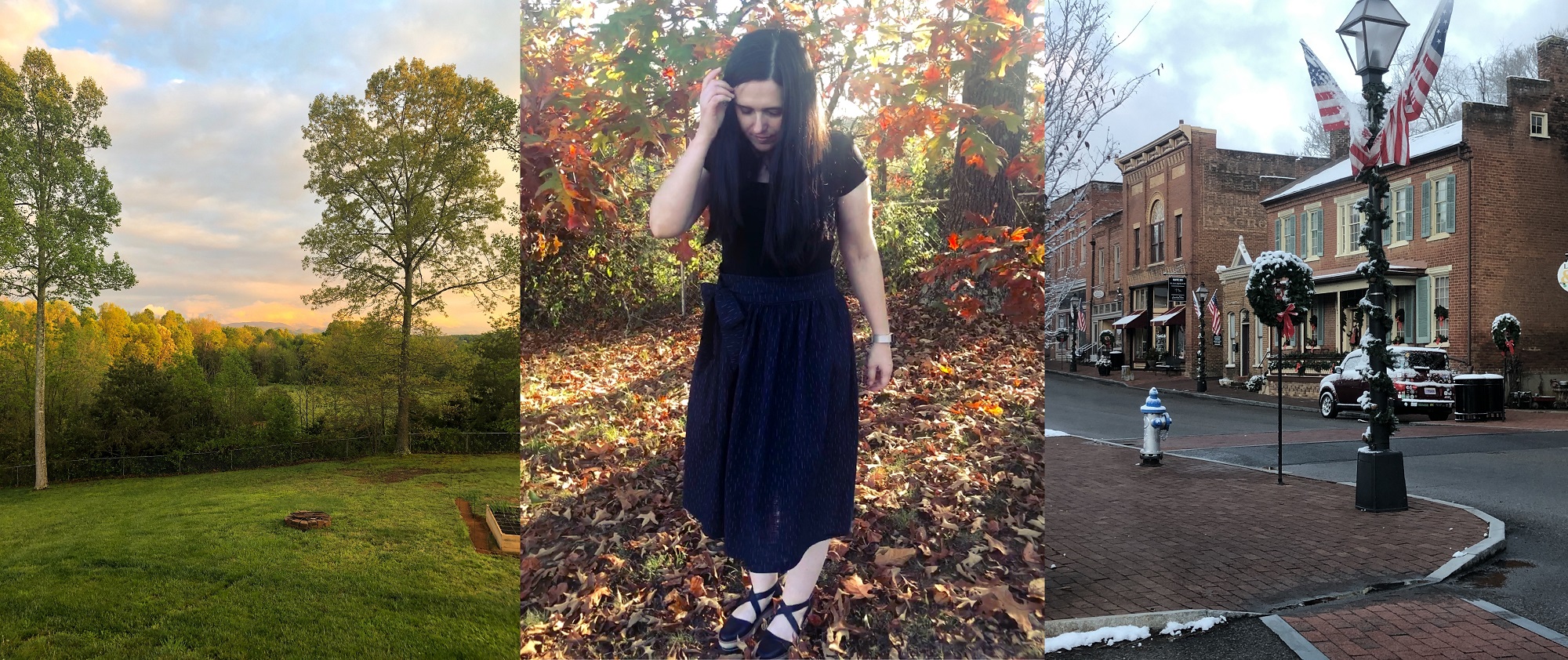
1/ Hello Julie, can you introduce yourself? Where do you live? Why are you settled in this state / region / city?
Julie explains that she lives in Jonesborough, the oldest town in Tennessee, located in the northeast of the state about one hour from Asheville, North Carolina, and one hour forty from Knoxville. She first came there in 2001 as an exchange student in high school, without having chosen the destination herself, since the host family selected her. Later, she returned in 2010 to complete a master’s degree, partly because she already had friends there and because studies would not cost too much.
She eventually married an American from the area, whom she had met in high school. At first, the couple only wanted to return to the region in general, thinking of Knoxville for better professional opportunities, but she was offered a job in the very town where her husband’s parents lived. Before that, they had spent eight years around Portland, Oregon. Julie explains that Oregon was more difficult for her: a very high cost of living, widespread poverty, many financial struggles, and a mentality she found too negative and judgmental compared with Tennessee, whose spirit she describes as very different.
2/ The advantages and strong points of your state / region / city?
Julie begins by mentioning the cost of living, which she sees as one of the major advantages. She explains that there is much less visible poverty there than what she experienced in Oregon, and that this translates into more peace of mind each month when paying bills. According to her, people therefore have more purchasing power, which helps many of them launch their own small businesses. She loves that aspect: many small shops, many people willing to take entrepreneurial risks, and a stronger feeling of that so-called “American dream” that so many people once searched for.
She also emphasizes the local mentality. In her eyes, many Southern states are shaped by a spirit of generosity. She gives the example that it is very rare to see people tip less than 20% in restaurants and that people are often ready to help or support local businesses, especially in hard times such as the pandemic.
Why these interviews matter
What makes this kind of article so valuable is that it reminds us there is no single “best place” in the USA. The answer depends on personal history, expectations, values, family situation, career opportunities, and the type of daily life one is looking for.
The United States can offer radically different experiences depending on the state, region, and city. That is why testimonies like Julie’s are so useful: they bring the subject back to lived experience instead of general assumptions.
This first part should therefore be read less as a ranking and more as a collection of perspectives. The point is not to decide for everyone where “the place to be” is, but to understand how different people build their own answer to that question.
Part 1 shows that choosing where to live in the USA is always a deeply personal decision shaped by lifestyle, values, and lived experience.
Why this question matters so much
Asking where “the place to be” in the USA really is sounds simple, but in reality it is one of the most complex questions for anyone considering expatriation or immigration. The answer depends on work, climate, family life, values, finances, personal history, and even one’s tolerance for certain cultural differences. That is why testimony-based articles are so useful: they bring nuance back to a question that is often treated too generally.
What works wonderfully for one person may be deeply disappointing for another. A state that feels affordable and welcoming to one expatriate may seem restrictive or isolating to someone else. The United States is too large and too varied for a single answer to exist.
The value of lived experience
Julie’s testimony already shows that point very clearly. Her experience is not just about geography; it is about cost of living, mentality, personal history, family ties, and the emotional relationship she has to different regions of the country. This is exactly what makes these interviews valuable: they reveal how place is experienced, not just described.
That distinction matters because expatriation is lived in daily life. It is not a theoretical map choice. It is a question of rhythm, atmosphere, budget, local culture, and the possibility of building a stable and satisfying life.
Why a two-part series makes sense
A single testimony is never enough to answer such a broad question. That is why a series matters. By placing several expatriate and immigrant experiences side by side, the article creates a more useful picture of the diversity of American life. It allows readers to compare and to recognize themselves in one story more than another.
Part 1 therefore works as an opening into a larger reflection: not “where should everyone live?” but rather “what kind of place could fit the kind of life you want?” That is a much more realistic and much more helpful way of approaching expatriation.
Part 1 shows that the best place to live in the USA is never universal: it always depends on the life, values, and priorities of each expatriate.
A question with no universal answer
One of the reasons this topic fascinates so many people is that it touches something very personal: the hope of finding not only a place to live, but a place where life might feel more aligned with one’s values, priorities, or long-term goals. In the United States, that search is especially complex because the country contains so many very different realities.
For some people, the ideal place will be tied to affordability and family rhythm. For others, it will depend on professional opportunity, climate, social atmosphere, or access to a certain type of lifestyle. This is why the same place can be experienced very differently from one person to another.
Why testimonies are more useful than generalizations
General advice about where to live in the USA is often too abstract to be genuinely helpful. Testimonies, on the other hand, reveal the concrete side of a place: how expensive it feels, how people behave, whether local life feels supportive or isolating, and how much opportunity there is to build something stable there.
That is exactly what gives this interview series its strength. It moves the conversation away from fantasy and toward lived reality. Instead of talking in broad stereotypes, it shows how real people compare states, regions, and cities through the lens of their own experience.
A first part that opens a broader reflection
Part 1 therefore matters because it does not try to produce a simplistic ranking. It opens a much broader and more useful reflection on expatriation in the USA. The goal is not to crown a single “best place,” but to help readers understand what kinds of places may correspond to different types of lives and expectations.
For future expatriates or immigrants, that is often far more valuable than any rigid answer. What matters is not where everyone should go, but where each person may actually be able to thrive.
The real “place to be” in the USA is always the one that best matches the life you want to build there.
A theme that speaks to many future expats
The question of where to live in the USA is so powerful because it often appears very early in an expatriation project, sometimes even before the visa or the exact plan is fully defined. It reflects both practical concerns and a deeper desire to imagine a future lifestyle. That is why so many people are drawn to this kind of interview series.
Readers are not only looking for information. They are often trying to recognize themselves in a story, to compare priorities, and to understand which trade-offs others accepted in order to build a life in the United States.
What Part 1 already reveals
Even through the first testimony alone, Part 1 already shows that the answer to “where should I live in the USA?” can never be reduced to weather, wages, or reputation. Human factors matter just as much: mentality, emotional comfort, the feeling of community, family closeness, and the everyday tone of a place.
That is what makes expatriate testimony so valuable. It shows not only the advantages of a city or region, but also how those advantages are actually lived and felt over time.
Why this topic deserves two parts
The subject is simply too broad for a single article. A two-part series allows more voices, more situations, and more contradictions to appear. And that is exactly what makes the discussion useful. The USA is not one destination. It is a country of radically different realities, and any serious reflection on expatriation has to acknowledge that diversity.
Part 1 therefore opens an essential conversation. It does not pretend to settle the issue once and for all, but it gives readers a grounded starting point for thinking about their own future choices.
Part 1 matters because it transforms a vague dream of living in the USA into a more realistic reflection based on lived experiences and personal priorities.